
Exploring Medicines
Discover how a variety of medicinal preparations have been made through the centuries and the essential pharmaceutical equipment used.

Echinites Cretaceus, c1745-1807
Glass jar, with plastic screw top lid and paper labels, containing specimen of fossilised sea urchin, Echinus esculentus. From the Burges Collection. Text on paper ...

Formicae, c1745-1807
Glass jar containing ants. From the Burges Collection. Text on paper labels reads ‘Catal. Mat. Med. p. 126, no. 55’ and ‘FORMICAE’. Ants were used to treat ...

Fossilised Unicorn Horn (Burges Collection of Materia Medica, late 1700s)
Without the knowledge and global information network we have today, medieval and later apothecaries often found it difficult to reconcile the fact and fiction of ...
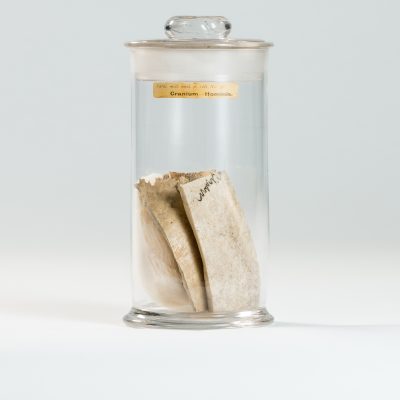
Fragments of Human Skull (Burges Collection of Materia Medica, late 1700s)
Although the thought of using human remains as medicine seems alarming to us today, when you look at the illnesses they were thought to be ...

Georgian Chemistry Cabinet,c1761-1820
Dating from the reign of King George III, this is a mahogany apothecary’s chemistry cabinet. ‘Inflammable bodies’ and ‘earthy metallic minerals’ are just two ...

Glossopetrae, ‘Tongue Stones’ (Burges Collection of Materia Medica, late 1700s)
These shark teeth have been mounted in silver casings for use as medicinal amulets. The name ‘tongue stone’ comes from the New Testament story of ...

Goa Stones (Burges Collection of Materia Medica, late 1700s)
Richard Bradley, A Course of Lectures, Upon the Materia Medica, Antient and Modern…, 1730

Gu. Lacca in Rotulis, c1745-1807
Glass jar containing four rolls of lac, a gummy secretion from the insect Tachardia lacca (Kerria lacca). From the Burges Collection. Text on paper labels ...

Gum Arabicum, c1745-1807
Glass specie jar containing specimen of gum of Acacia arabica. From he Burges Collection. Label on body of jar states contents as GUM ARABICUM. Label ...

Gum Lacca Croton, c1745-1807
Glass jar, with plastic screw top lid and paper labels, containing specimens of lac, a gummy secretion from the insect Tachardia lacca (Kerria lacca), on ...